
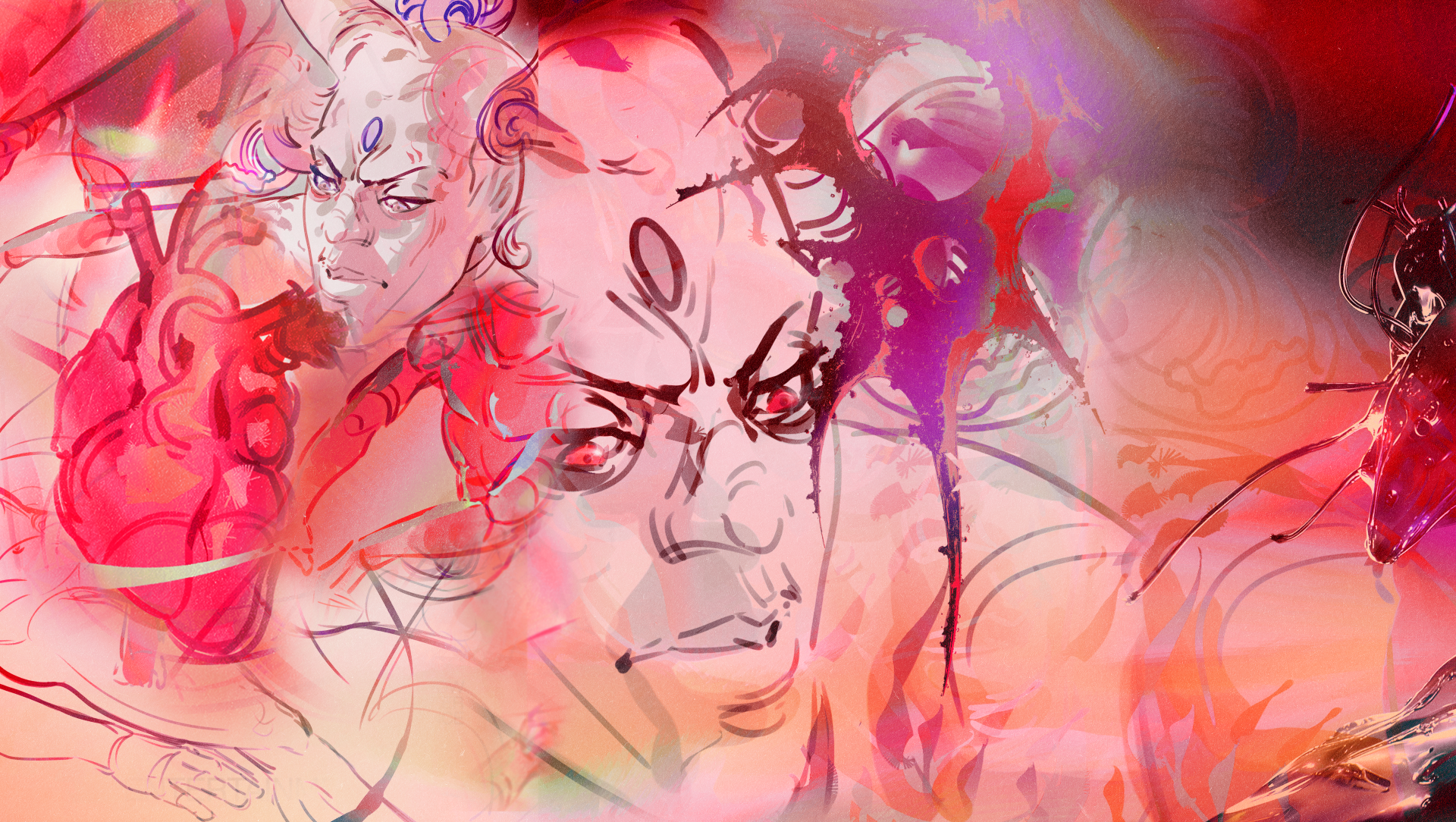
The Obsessors transforms the stage into a ritualistic, comedic space that mixes spiritual satire, body movement, and collective performance. Drawing from the Brazilian Umbanda desobsessão practices, the show invites audiences to laugh, reflect, and confront what drives desire, belonging and assimilation.
1. Comedy and Ritual
Your work blends sharp comedy with ritual, sometimes in surprising ways. How does humor function in The Obsessors; is it a way to invite people in, to break down barriers, or something more challenging?
I have spent my life in social movements, dealing with serious and heavy questions such as the democratization of art practices, the struggle for collective lands, ethnic minority groups, non-Western cosmologies, queer feminism, decolonization, and education. At some point, I became concerned with how our movements can have their narratives captured by forces that seek to control them, and not only the movements, but also our transformative forces, our labor, our energy, and our concrete wishes for the planet. I began searching for disruptive, dissenting forms that would allow me to remain in touch and to be in contexts where, suddenly, a window of transformation, a window of hope can open. Places where what is invisible is somehow so present, that it leaks into reality allowing us to surf its waves. To find this window of magic, I turned to places, rituals, and gatherings where I feel there is “no one” particularly able to fully control it, practices that have existed for centuries and that not even the participants might fully understand how they came about, where memory, overlapping historical processes, and embodied experiences are leading the gathering. I shifted my attention to popular shows, street parties, community rituals, and non-institutionalized art practices. In this sense, I found in comedy a key to trigger this small window, this rare and brief moment where we can disidentify from suffering and experience rage, grief, release, and finally find within ourselves the space to maybe say something that was never said before, to see something we might not have been able to see before, to feel in a new way, and through that, dream of a new future. This is also how I developed the method Re-telling Structures, which I use to create my group pieces, alongside working principles such as “Mobilize the pain until it turns into possibility.” I believe comedy has the power to break familiarity and destabilize dominant regimes of how we understand the world actually works, and through that, stay with what we don't understand.
2. Desire, assimilation and performance
This show puts desire , not just for connection, but for acceptance within dominant cultures, under the microscope. How do you see the desire to assimilate showing up in the performance, and what emotional or social impact do you think it has on both performers and audience?
I believe the desire for assimilation, and by this I mean the desire to belong to a hegemonic culture, can drive us very far from the path our ancestors wished for us. It is also currently a leading cause of demobilization and competition, preventing solidarity among our movements. I believe our ancestors pass on to us two precious stones, their best wishes for the future and their deepest fears, and it is sometimes difficult to understand which one to follow. Often, when there is mass displacement in one generation, the next one seeks protection by trying to access the very culture that dominated them. In this way, many of us did not receive the language of our ancestors, for example, because they did not want us to look like, or be perceived as, immigrants, marginalized, or minority people, as they knew the suffering we would go through. They wanted us to “win.” At the same time, many of them did not, or could not, assimilate. There is another path, what I understand as a run-away culture, a culture of those who refuse to serve dominating masters and who concretely create alternatives such as collective diasporic lands, new forms of peoplehood and kinship, remaining in touch not with the fear of exclusion, but with the desire and the knowledge of the voice of the planet. I was born in a Candomblé house and I am a Roma person, I am also queer, and like many of us, I come from peoples who chose to remain with what they understand as a healthy way of inhabiting the planet, with their visions and dreams, ones that are not based on militarized nation-states controlling territories through mass violence, the same could be said about control over bodies. We are all home, we all belong here. Militarized control is not the direction we want to follow. By showing the desire for assimilation, and how strong and difficult its grip is within us, this desire to belong to the homogenizing culture, to become part of something you may never fully be part of and that will erase your ancestral knowledge, I want to offer younger generations both a reminder and a question, is spending your whole life trying to belong to something that you can never fully be part of, and that you do not actually believe in, a sustainable way for the permanence of peoples and of the planet? As we say in our culture: “Serve well, will only lead you to serve always".
3. Collaborative energy: working with the ensemble
In The Obsessors, you work closely with a group of performers (including Bebel Carvalho, Neslihan Kaymak, Hanna Rojer , Nana) to create the piece. How do you collaborate with your players during creation? What does that process look like, and how does it shape the material on stage?
Well, first of all, I love working with groups. Since my first experience directing students in 2011 at the House of Culture Brasilândia, an outskirt neighborhood of São Paulo with one of the highest rates of state violence in the Americas, I learned to collaborate with art projects and healthcare institutions, the prison system, social assistance, and feminist organizations working to prevent femicides. It was there that I understood the power of collective gatherings through art practices and how they can reshape community dynamics by addressing concrete problems we deal with on a daily basis. Since 2024, I have been working with auto-fiction and auto-theory, where participants scrutinize their internal and cosmological landscapes to arrive at an understanding of the world that can only be articulated from the unique position from which they see it. This approach comes from feminist and queer movements in literature, which argue that one of the only ways to overcome white, cis, hetero canonical understandings of the world is through expressing the lived and embodied knowledge of marginalized people. We look at the world like a mountain, and each of us sees only one part of it, so we need to come together, to listen to each other, to interview each other, so we can assemble these pieces and try to see again, in an unfamiliar way, what we think we already know, and from that propose something new for the next generation. I have been developing directing and artistic research techniques for group facilitation and community-building projects for over 20 years, and these are the expertises I bring into creation processes. I have collaborated within collectives for many years, but currently I work as a director with the foundation The Goldfish Bleeding in a Sea of Sharks, creating co-productions in a more traditional structure. I choose performers through open calls, where the main selection criteria are desire and relevance to their own lives and artistic trajectories. I look for whether a specific project can be meaningful for someone’s own research and whether we can meet in the middle, each from our own positionality. Sometimes performers have no prior experience at all, as I do not select based on CV, name, profile, or technical capacity. In the case of The Obsessors, everyone involved had some form of traditional spiritual practice from their own backgrounds. For example Hanna Rojes is an important community builder in somatic practices with roots in Curaçao, and Nana and Neslihan bring their spiritual backgrounds from Turkey and Cameroon. In the process, I arrive with a methodology, and we work through it collectively until each performer has generated enough material and we have built a shared vocabulary. From there, they develop their own scenes based on their own references, experiences, and urges, so that what appears on stage is not representation, but position taking. For me, self-determination is the most important aspect when we think about how to bring our cosmologies into visible spaces such as the theater.
4. From workshop to stage
You’ve led workshops like We Dance Together, exploring movement, obsession and collective ritual with a broader community. How does that work with participants feed into your relationship with your cast and the way The Obsessors takes shape?
From the workshop to the stage, what feeds The Obsessors comes from a real ritual practice I learned in Brazil since I was very young. My grandmother, together with other elderly women, would offer weekly cleansing "desobsessão” for free, a practice of de-obsessing, working against negative and intrusive spirits called “Obsessors”. This was done every week, for anyone, as part of a community landscape and a public service. At the same time, it is a very marginalized practice, not something people showcase or institutionalize, even within the vast and diverse Brazilian shamanic landscape. Because of that, it is very surprising for me to see how much resonance this ritual has in the workshops. People come from very different cultural and cosmological backgrounds and immediately start recognizing something. They say, in my culture we also do this, but in another way. They speak about how they relate to the dead, how they negotiate with invisible forces, how they understand that we are vessels absorbing invisible information, and that the body has the capacity to make these forces manifest. When I was invited to lead workshops like We Dance Together, I could not imagine the scale of the interest. It became full very quickly, and even had to be repeated. What I try to do in these spaces is to create a diplomatic ground. I do not want to impose any cosmology. I translate the ritual into a structure where each person can approach it through their own background, their own heritage, their own way of naming what they are dealing with. It is not about homogenizing experience, but about allowing multiple experiences of being in touch with the Planet to coexist and be activated through the body. Every time I tried to make the work lighter, less explicitly about possession, more framed as performance or movement, people resisted that. They did not want a diluted version. There is a real desire to place the body in service of something collective. To deal together with negativity, darkness, disturbance, whatever name we give to it. And they do it with a level of commitment that surprised me. What I am trying now is to bring this willpower into the stage. But the stage is not a neutral space. There are also invisible forces operating there: they are institutional, economic, curatorial, and ideological forces. They decide who can be visible, who stays out, what is considered high art or community work, what is framed as sophisticated or not, which political discourses can circulate and which ones must remain to be hidden. These are also forms of invisible control, even if they are not named as such.In the workshops, the ritual can happen more directly. On stage, it is harder to perform it, because these other forces are constantly shaping the conditions of appearance. The Obsessors is exactly this negotiation, how to bring a marginalized, community-based ritual into a highly controlled theatrical system without neutralizing it, and without de-politicizing it.
5. Balancing laughter and provocation
Audiences laugh, but often the humor points to something uncomfortable or unsettling underneath. How do you achieve that balance and what do you hope people take away when the laughter fades?
I try to build my pieces as multi-layered experiences where different audiences can enter from different entrance points, it’s a work of generosity and of constantly searching for access doors. For a long time now, the audience has been at the center of my practice. For example, there is always a layer of music, of dance, of bodies in movement, something that younger audiences can immediately connect to, because they want to see music, a dance they relate to, and people exploring their performing bodies. I don’t impose that the discourse must be understood, I try not to make that layer mandatory. At the same time, if someone is interested in a heavier political and critical discourse, it is also there, being delivered from the beginning so they can enter in dialogue with me and the team through it. The work holds these parallel layers without forcing a single way of reading. I try to make something people can understand from their own reference points, without simplifying the complexity of what is being proposed. I also work from the understanding that we are all already moving across the planet, even if we don’t realize it, and in every city I encounter people shaped by diasporic and intergenerational movements. I try to acknowledge that and bring these influences together through the performers I work with and my audience outreaching, proposing the theater as a diplomatic space for encounters, in which we can eventually experience realities that are not our own. I don’t necessarily work with the concept of provocation. Most of the time, people who feel provoked are reacting to something else, often a need to control institutional theater spaces, to homogenize them, or a feeling of entitlement to define what artists should or should not say, do, or sell, and especially to define what their canon of “high art” is and who it is for. There is also a difficulty that some people have in recognizing me as a director, because I am a queer non-binary Roma person born in Brazil, coming from multiple cultural references that don’t reinforce national borders and instead create alternatives to them. For some, the very presence of immigrants in decision making positions on European stages can already be perceived as a provocation. So for me this is much more about power and territory disputes than about the work itself. What I often see is that many audiences are actually interested and even revolted by the lack of space for works that carry lived and embodied knowledge, works that know how to address power struggles, the variety of realities on the planet, and at the same time know how to communicate and connect with their audiences.Those are actual knowledges that depend on life experience to be acquired. I keep this balance in the production format, more than in the piece in itself.
6. After the show
When someone walks out of The Obsessors, what do you hope stays with them? Is it a question, a feeling, a new way of thinking about desire, assimilation, or even how we relate to one another?
Yes, absolutely. The desire of assimilation is a central question that The Obsessors is helping me to work through. I see how it is already opening space for performers and participants to reflect on this, how the desire to belong to a hegemonic culture that, very often, has dominated your ancestors or has supported ways of occupying the planet that do not sustain the permanence of all people(s), beings, the planet, and multiple experiences of reality. What we experience is that after processes of genocide, ethnocide, or mass displacement, whether in a single moment or across centuries, the following generations often try to protect their descendants from the hardships they lived through. This can lead, for example, to not transmitting language, culture, or ancestral knowledge, knowledge that could be essential for future generations to resist, to disrupt, to refuse, and to create alternatives that could lead to a self-determined collective life. The knowledge of, for example, talking to the dead, or with the voices of the planet, or to recognise invisible forces that live and speak through us, such as obsessors. In contemporary times, obsessors can also be understood as invisible forces that try to capture desire, such as radicalization, data manipulation, and political narrative disputes. The desire of assimilation can make us invest a great part of our lives trying to belong to structures that were never made for us, that will never fully accept us. So the question becomes how to redirect that energy into creating other structures that can actually hold our dreams and desires, not only for ourselves, but for those who come after us. Together with the artist and somatic abolitionism practitioner Anne de Andrade, I am developing a somatic and embodied practice that engages with this. We imagine that our ancestors passed on to us two precious stones. One is a diamond that carries their fears. If we follow those fears, we remain trapped in the desire to assimilate into systems that have often destroyed other ways of living and relating to the land that were more sustainable for people and for the planet, whether in terms of gender, ideology, identity, nationality, or cultural affiliations. The other stone carries their wishes for the planet, everything they hoped for. In that sense, we are already the best they could leave as a gift. If we follow the horse of desire that lives inside us, we can begin to sense what the next move is, in our communities, in our social movements, and in the ways we choose to relate to each other. I was educated through social programs for the democratization of art, and I have been part of movements led by artists my whole life. I will continue to insist that artistic practice must remain connected to the right of everyone to contribute, to participate, and to shape the worlds we live in. So, “keep looking to the invisible, trying to see possibilities, even where it seems there is none…”.